Wednesday, 7 June 2017

Here's What Climate Change Looks Like To Uganda's Coffee Farmers

If you’ve ever bought coffee labeled “Uganda” and wondered what life is like in that faraway place where the beans were grown, now’s your chance to see how climate change has affected the lives of Ugandan coffee farmers — through their own eyes.
Rising temperatures and prolonged drought can make coffee trees less productive and increase their exposure to pests and diseases. This is especially a problem in Uganda, where nearly all of the coffee is produced by small farmers who have little access to irrigation or other modern farming conveniences. Coffee is by far the country’s most valuable industry: It accounts for one-fifth of export revenue, and about 1 in 5 Ugandans rely on it for part or all of their income.
Yet climate change could slash the country’s coffee production in half by 2050 —a loss worth $1.2 billion, according to a 2015 economic analysis commissioned by the Ugandan government.
Because Uganda is a relatively small player in the global coffee market, disruptions there won’t necessarily affect the price of your morning joe in the U.S. But within the country, a disturbing new reality is taking root. To find out exactly how Uganda’s coffee farmers view their experience of climate change, I recently equipped a dozen of them with disposable cameras.
None of the farmers had ever used cameras, and the ones I gave them were pretty low-quality. But I was amazed by the more than 300 images that the farmers delivered. Many are candid, well-composed and achieve a level of intimacy that would be hard for an outsider to capture. You can access the full Flickr album here.
The photos show the struggles of everyday life for small family farmers who are facing drought on Mount Elgon, one of Uganda’s oldest and most prestigious coffee-producing regions. We see cows and chickens; children on their way to school; people bustling around water sources; and plenty of manual labor around the farm. That might all sound a bit mundane, until you realize the photos are really a window into the minds of a vulnerable population living on the front lines of climate change.
I set up this project in March with a group of coffee-focused agronomists at the Kampala offices of the International Institute of Tropical Agriculture (IITA), a nonprofit research organization. We found our 12 volunteers — six married couples spread across low, middle and high elevations of Mount Elgon. We gave each a quick briefing on how to operate the camera, then asked them to document the impacts of climate change. We left those parameters intentionally vague so the farmers would feel free to define “climate change” in their own terms.
A week later, we got the cameras back — and with them, an unfiltered glimpse into how the farmers understood their situation.
Among the intriguing images is a sort of still-life, shot on the farm of Sam Massa and his wife, Robinah Muzaki. They live in a mud-brick house in the mist-shrouded upper slopes of the mountain, surrounded by coffee trees that Massa’s great-grandfather planted more than 100 years ago. The photo shows artifacts from the farm that represent the effects of rising temperatures: leaves affected by fungal disease; a stem-borer beetle, which lays eggs inside coffee trees, causing branches to wither; a clutch of red coffee berries that Massa says “are not properly matured.”
“When you open the inside, there’s nothing,” he says.
Massa’s wife is fond of a picture she took of the family cow. She says that because drought had severely reduced the last coffee harvest, the family was desperately looking for other ways to raise cash. When she took the picture, she and Massa were considering selling the cow. By the time the pictures were developed, the cow was gone. (A calf, also seen in the image, is still on the farm.) So the picture became a memorial to something climate change had taken from the family.
“I had to sell that cow to pay the school fees for the kids,” she says. “If the yield of coffee had been good, I wouldn’t have needed to sell it.”
There were other revelations, things that people might not normally associate with climate change, but that are painfully obvious to those living in its harsh reality. Pictures of nondescript dusty roads show the challenges of transporting produce to market; photos of children in uniforms represent school fees, which is many families’ biggest cash expense — paid for by coffee.
“We are in poverty now,” says Michael Lullonde, whose wife, Lofisa, snapped the picture of a school seen on this page. “To take our children to school, or even get food, is very hard.”
Peter Magona, another of the photographers, says that despite the obvious change in climate, for him and other farmers on the remote Mount Elgon, there’s no other viable livelihood than coffee: “If you look around, you can see the environment has changed considerably. There’s no rain. The yield is very poor, and the income is very poor, due to this prolonged drought. But coffee is our cash crop, and we cannot drop it. We depend on it.”
There are many other stories hidden in the photos, too. Over the coming months, IITA scientist Onno Giller plans to finish interviewing the farmers about the images they took and compile the findings in a peer-reviewed research paper. In the meantime, Massa plans to use the prints of his photos as a teaching tool, to encourage his neighbors to take a second look at their own farms and see what they can do to climate-proof their practices.
by Tim McDonnell

Uganda Gets Shs652 Billion for Rural Agriculture Financing


Kampala — The International Fund for Agriculture Development (IFAD) on Tuesday announced that Uganda had been allocated $168 million (about Shs651.6 billion) for rural transformation through agriculture. The allocation is aimed at enabling rural farmers to access long term loans for agricultural practice.
The fund, which has a duration of seven years, is being administered under the IFAD arrangement called the Project for Financial Inclusion in Rural Areas. In Uganda the project is being implemented by the ministry of Finance and it entered into force in November 2014.
In an interview with Daily Monitor at Speke Resort Munyonyo on Tuesday at the official opening the fourth Regional Conference on Implementation of Rural Agriculture Transformation, with the theme financial inclusion, IFAD regional director of Eastern and Southern Africa Division, Mr Sana F.K. Jatta, said IFAD has 45 ongoing projects in 22 countries in the region with the total portfolio of $1.7 billion.
"Out this amount Uganda has been allocated $168 million, in the category of a medium size country programme," he said.
Ugandan farmers and other business communities are always faced with the problem of limited access to long term finance.
Mr Jatta said Uganda's project is competitive and very innovative which is encouraging because the projects in Uganda have provided productive and beneficial support for the farmers involved in it.
The IFAD project encompasses funds from IFAD itself, government contribution, beneficiaries' contribution, development partners such as the World Bank, among others.
Mr Jatta added if all the funds from the IFAD are added together they total to $3.5 billion, being administered in a cost effective way to spur development.
Uganda's projects include palm oil in Kalangala and the surrounding areas; while in other areas it includes sunflower, simsim and beans.
Mr Jatta said the way the IFAD project is designed based on Public, Private Producers Partnership.
"We started this programme in Uganda in 1995 in Kalangala and it aims at increased productivity of the farmers as well promoting financial inclusion through the government. We do this by reaching the poor with the financial services, train them on how to engage in linkages of markets, train them on business development plans," he spelt out.
IFAD is an international financial institution and specialised agency of the United Nations dedicated to eradicating poverty and hunger in rural areas of developing countries.
Uganda's minister of Agriculture, Mr Vincent Bamulangaki Ssempijja, who opened the conference said: "Increasing household agriculture is one of government strategy of rural transformation."
The state minister of microfinance, Mr Kyeyune Haruna Kasolo, said government's financial inclusion policy aims at enabling the rural farmers to have increased access to funds for agricultural development.
However, the director global engagement, knowledge and strategy division, Mr Ashwani K. Muthoo, told the conference that the funding gap for rural agriculture financing is still huge.

Monday, 24 April 2017

Why are armyworms attacking Africa's crops?


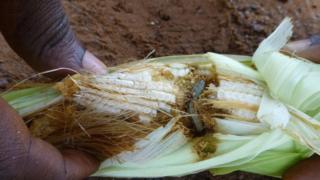
The army worm burrows into cobsImage copyright

Scientists warn that parts of southern Africa already hit by record droughts now face another potential food crisis because the invasion of a crop-eating pest, known as the "fall armyworm".

Global experts are meeting in the Zimbabwean capital Harare to come up with a plan to combat it.

What is the fall armyworm?

The name is a bit misleading. It is not actually a worm, but a hungry caterpillar that eats crops before turning into a moth.
It is a new pest, not to be confused with the similarly named "African armyworm", which has been present in the region for many years.

Where did it come from?

It is native to the Americas, but experts are not sure how it reached Africa.
One theory is that the eggs or the caterpillars themselves hitched a ride in some imported produce, or even made it on board commercial flights.

Why is it such a threat to farming?

  • It is very hungry (and not picky) - This pest targets maize (corn) and other cereal crops, like its African namesake, but it also attacks cotton, soybean, potato and tobacco crops. When it does invade, up to three-quarters of the crop can be destroyed.
  • Unknown enemy - Governments, communities and farmers have no previous experience of dealing with the new pest, which may be even harder to deal with than its native equivalent.


Image captionArmyworms can destroy entire fields

  • It is fast - According to the UN's Food and Agriculture Organisation (FAO), it has taken only eight weeks for the pest to spread to the six southern African countries where there are suspected infestations.
  • It travels far and wide - The caterpillar stage does the damage but "it's the adult moth that migrates long distances and that's how it's managed to get round Africa," says Professor Ken Wilson, an expert on armyworms.
  • It is not just targeting any old crop - Maize is the primary food staple in many of the areas where the pest has been identified.
  • It is hard to find - The fall armyworm burrows right into the stem of maize plants, concealing itself from view and preventing farmers from spotting the problem early.
  • Bad timing - It comes after two years of record droughts, which have already affected more than 40 million people in the region, making 15% less food available, according to the UN.

Where is it?

South Africa, Zimbabwe, Malawi, Zambia, Namibia and Mozambique are the chief suspects among southern African countries, according to the FAO.
The presence of fall armyworm in Africa was first reported on the island nation of Sao Tome and Principe in January 2016, it says.

Chimenya Phiri, Malawian farmer:


"These army worms attack the maize leaves, the flower and even bore into the stalk. And because they dig into the stem of the plant, it is difficult to notice them. It is only on close inspection that you realise almost the entire plant has been destroyed"

Other research groups have also reported it in parts of West Africa, including Nigeria and Ghana.
But the governments of Zimbabwe and South Africa are the only ones to have publicly confirmed that they have a problem with this specific pest.

How much damage has already been done?

We don't know exactly, because many affected countries have not provided data yet.
Finding out the number of hectares affected and the intensity of the pest is one of the main aims of the emergency summit in Zimbabwe, the UN says.


Image captionSouth Africa, affected by the new pest, is the largest corn producer in the region

South Africa, the region's biggest maize producer, has confirmed the destruction of crops from the pest in six different provinces.
The Zambian government has said that 130,000 hectares (321,236 acres) of land have been affected, with the prime suspect the fall armyworm.

What can be done to stop it?

Insecticides. Chemicals can be used to deal with the pest in its early stages, but after that it becomes much harder, and some populations of fall armyworm have developed resistance, according to experts.


Image captionScientists want a co-ordinated response to the invasion

Other approaches involve digging trenches, employing natural predators, like birds, to eat the worms or even burning the crops, according to David Phiri, the senior FAO official in southern Africa.
Zambia, thought to be one of the first places hit by the outbreak, used army planes to spray affected areas with insecticides, which has enabled some crops to recover, an official at the national disaster agency told the BBC.

What next?

The warning from the FAO is a bleak one, suggesting that things will probably get worse before they get better.
"It has just started - even those countries not currently affected should prepare themselves for possible infestations," Mr Phiri told the BBC.


Image captionBotswana suffered its worst drought in 30 years in 2015

Scientific institutes have also raised the alarm, describing the pest as a major threat to food security and agricultural trade in the region.
However, if there is a "co-ordinated approach" from countries across the region, then that's where the solution might lie, Mr Phiri says.
"We cannot eradicate it, but we can find ways of managing it."
Un affected maize close to harvest


Saturday, 8 April 2017

Kenya investigates reports of armyworms in maize fields


armyworm-caterpillars
NAIROBI (Reuters) - Kenya has sent a team of scientists and other experts to investigate reports of crop-eating caterpillars known as fall armyworms in maize fields in the western region of Trans-Nzoia, a senior government official said on Wednesday.
Neighbouring Uganda confirmed last month that the pests had attacked crops on farms in about 20 districts in the country, heightening concerns that they could spread into Kenya.
Johnson Irungu, the director of crops at the ministry of agriculture, said the team was sent in two weeks ago after reports the pests had appeared in maize crops being grown by farmers using irrigation.
Kenya is suffering from a drought that has left about 2.7 million people in need of food aid and driven up inflation to a near-five year high.
Irungu said they were working with local authorities to deal with the armyworm attacks.
"We are also requesting farmers to at least control them within their boundaries," he said.
The caterpillar is native to North and South America, though it has already spread to other parts of Africa including Zambia, Zimbabwe, Malawi, South Africa, Namibia, Mozambique and Democratic Republic of Congo.
The United Nations fears it could reach Asia and the Mediterranean in the next few years.

(Reporting by Duncan Miriri. Editing by Jane Merriman)

Uganda’s president supports bill allowing country’s farmers to grow GMO crops

The pressure to pass the Biotechnology and Biosafety Bill 2012 has started building up in recent weeks after some parts of the country experienced food shortages due to the prolonged drought.
Proponents of the bill believe that once it is passed, the already developed varieties of food crops that are drought-resistant will be given to farmers to plant and this would end hunger in Uganda.

HE.President Yoweri Museveni
President Yoweri Museveni says the bill will help the country resolve some of the problems the agriculture sector faces. President Museveni, on March 20 [2017], while touring a demonstration farm at Kawumu State Lodge in Luweero district, is quoted to have said that the bill should be passed to help improve farming practices, backed by modern research and technology.
This month alone, the Uganda National Farmers Federation (UNFFE), researchers from National Crops Resources Research Institute (NaCCRi) in Namulonge and President Museveni called upon Parliament to quickly pass the Biotechnology and Biosafety Bill 2012.
Farmers said the failure by the legislators to pass the bill has denied them the chance to access modern technologies being developed by the National Agricultural Research Organisation (Naro) centres spread across the country.
The GLP aggregated and excerpted this blog/article to reflect the diversity of news, opinion, and analysis. Read full, original post: Pressure to Pass GMO Bill Gains Momentum

Saturday, 25 March 2017

Avoid Overmilking: Can damage teat ends and compromise udder health

The traditional practice of milking all cows completely during each milking could be leading to teat damage in your herd.
Overmilking can damage teat ends and compromise udder health—putting cows at greater risk for infection. But a simple test can help you determine if you are over- or undermilking.
The recommendation to milk all cows completely—every time—has been revised due to recent research and field experience. It is impossible to milk a cow completely dry. There will always be some milk in the udder, even after “complete” milk out, because she is constantly making milk.
In the past, it was believed that all milk needed to be removed from the udder to maximize milk yield. However, breeding for high milk yields has provided cows with a high alveolar capacity. Due to this, cows are more efficient as milk producers.
Overmilking starts when the milk flow to the teat cistern is less than the flow out of the teat canal. Fluctuations within the mouthpiece chamber vacuum can occur. If the vacuum in the cistern is higher than beneath the teat, reverse pressure across the teat canal may increase bacterial infection.
Reverse pressure gradients occur only during milking of empty teats, and overmilking will therefore increase the possibility of bacteria entering the teat.
Teat-end health is also greatly affected by overmilking. Hyperkeratosis of the teat, which is a thickening of the skin that lines the teat canal and external orifice, is often experienced in herds with long unit-on times.
Hyperkeratosis doesn’t allow for teats to be thoroughly cleaned and can lead to bacteria being left behind—which also can lead to an increased somatic cell count.
The good news? A simple strip-yield test can evaluate the completeness of milking, and it can be done by anyone on the farm—either by hand or with a unit.
To test by hand, immediately after milking, hand strip each quarter for 15 seconds, collecting the milk in a container. A properly milked cow should have about 1 cup of milk left in the udder. If there is more or less, then a milk-out problem may exist on your farm.
Performing this test with a milking unit requires a little more precision and a milking meter. Reattach the milking unit within 30 seconds of automatic removal and apply downward pressure. Continue applying pressure for 15 seconds before removing the unit. Record the amount of milk that is harvested. Once again, about 1 cup of milk should be left in the udder.
If you discover a problem, many factors could be at fault. Milking machines must be properly maintained, and if automatic detachers are being used, adjust for timely removal of the milking unit. If your farm manually detaches units, employees must be more consistent in removing the unit as soon as “end of milking” is reached for each animal.
Timely unit attachment and proper let down, quiet cow handling and timely unit adjustment, and proper alignment are also critical.
A few simple steps can prevent overmilking and can help decrease your overall herd somatic cell count. By following these guidelines, your herd can reach optimum udder health.

Lucy Mwaniki has embraced mechanisation in her potato farming venture, boosting her yields.


Lucy Mwaniki, the owner of the two-acre potato farm, stands on the edge, near where several bags of harvested potatoes have been placed, looking at the ongoing work as she smiles.
She is among the few farmers in the potato growing region who have embraced mechanised farming.
“I have been using tractor-driven planters and harvesters for the last one year and so far I am happy because my costs have come down,” says the businesswoman.
The tractor, hired from Nyandarua county government, is fitted with the different machines to suit all stages of potato production.
The machine ploughs, plants, applies fertiliser and harvests, making her work much, much easier.
“My parents gave up on potato farming in 2015 and I began figuring out how to use the land,” she recalls.
While potato farming was her agribusiness of choice, she feared how she would manage the many workers associated with the farming yet she lives away in Naivasha.
She sought advice from agricultural extension officers on land preparation, seeds and management of the crop.
Lucy later bought pure Shangi variety seeds from Kenya Agricultural and Livestock Organisation in Ol Joro Orok and planted for the first time in February last year.
Her initial capital was Sh260,000 that went on leasing the land from her parents at Sh25,000 a year, land preparation and buying of 40 50kg bags of seeds at Sh2,000 each.
EMBRACED MECHANISATION
The crop did well, but she spent Sh25,000 to pay 10 workers who harvested the produce for 10 days.
“This was besides the Sh1,500 I spent on fuel every day while driving from Naivasha to the farm. The harvesting stretched for 10 days because it was then raining and at some point, the workers refused to work and demanded that I must cook lunch for them,” she recalls, noting the food cost her an extra Sh3,500.
Due to delayed harvesting, she further had to hire people to sort out potatoes, some that had already started rotting or had blemishes.
“Since they were using hoes, some of the workers cut the potatoes rendering them unsaleable that I had to give them.”
She had targeted 300 50kg bags but ended up with 220 which she sold at Sh2,000 each to traders.
Later, she learnt that if she had used machines to do the work, she would only had paid Sh10,000, Sh5,000 per acre, for the work that would have taken three hours.
She has embraced mechanisation since then. Two weeks ago, she harvested 140 110kg bags of potatoes and 50 50kg bags of seeds, thanks to machines.
“Mechanised farming is the best way to overcome post-harvest losses and save time and money. The harvester does not cut potatoes minimising losses,” Margaret Mungai, an agricultural officer in the Nyandarua says.
She adds machines are sanitised and, therefore, cannot infect the soil unlike jembes which are used from one farm to the other.
“You cannot plant manually and try to mechanise the harvesting. It will not work. Use have to use machines all through,” she advises.
By RACHEL KIBUI

Nicholas Kirimi is making Shs. 20,000+ per month from 2 Friesian cow’s in Meru county Kenya

45
A few kilometres from Meru town, off the Kithirune market in Nkando village, South Imenti, sits a farm known as Home of Friesians.
The over half-acre farm owned by Nicholas Kirimi, 31, hosts a cowshed, napier grass, maize and sweet potato vines for the animals.
“Many people here keep cows as a tradition and concentrate on tea farming but I have taken a different path by commercialising my venture,” says Kirimi, who set on the project three years ago on the land he inherited from his grandfather.
He used his savings to buy two Friesian heifers at Sh50,000 each, and employed two workers to manage the project for him as he toiled in employment at the county government, where he works as a cameraman.
“I got the two workers because then I was green in farming. I learnt from them how to take care of the cows,” says Kirimi, who holds a diploma in photography.
He now has eight cows, seven which are Friesians and one an improved Ayrshire. He milks the two cows that he started with, getting 20 litres from each every day.
“I bought the Ayrshire to find out its production. If it will not be good when it calves, I will stick to Friesians.”
He has invested in a generator-driven chaff cutter which he uses to chop the napier grass and potato vines into smaller pieces.
PATIENCE AND RESILIENCE
“When I am feeding the cows with dry maize stalks, I add molasses to make them palatable. I also feed them dairy meal to boost milk production for those that are lactating. I offer them the bulk of the feeds in the morning and little amounts in the afternoon.”
With dairy farming, he notes he can choose where to supply his milk.
“Tea farmers at times have to sell their produce at low prices to avoid incurring more losses. But with the milk, I can add value if I feel the prices do not favour me,” says Kirimi, who sells his milk in Meru town at Sh55 a litre and makes about Sh20,000 profit in a month.
The farm, according to him, now sustains itself.
“My aim is to have about 15 cows to make the venture more profitable as I improve my breeds.”
His challenges include high cost of commercial feeds and artificial insemination that goes for between Sh1,000 and Sh7,000.
“My dream is to go into dairy farming fully in the near future. There used to be a notion that farming was only for retired teachers and civil workers. As young people, we have the energy to do this kind of work when we still have the energy,” he opines.
“Most youths consider farming dirty but with the rising levels of unemployment, it is the best bet as long as one is resilient and patient. Definitely, it will not pay overnight but it will surely do.”
Meru County Director of Livestock David Mugambi says Ayrshires and Friesians are good breeds and do well in many areas across the county, including in Meru.
He attributed low production of milk to underfeeding cows.
He adds the best feeds for increased milk production are silage and Boma Rhodes grass.
 Good quality cow that offers farmers much better returns
  1. Friesians have distinct colour, usually black and white or black red.
  2. They are famed for their large dairy production, averaging 23,285 litres of milk per year.
  3. Healthy Friesian calf weighs 40 to 45kg or more at birth. A mature one, on the other hand, weighs 580kg  and stands 147cm. Friesian heifers should be bred by 13 to 15 months.
  4. This will enable them to calve at between 23 and 26 months.
  5. The gestation period is about nine and a half months.
By DAPHINE BILIMA